Showing posts with label high school biology. Show all posts

Tuesday, February 21, 2023

Why do Antibiotics stop working? | An NGSS aligned lesson


I have been struggling to rework my lessons to meet the NGSS framework.  It's so easy to just stand up in front of the students and lecture, but I know that is not the best way for students to learn.  I am one who need example lessons so I can model my redesigns around them.  That is why I like exemplars like this.  I can see how it should be done so I know what to do when I am making my own updates. 

This lesson is actually part of a 29 lesson unit so there are lots of examples to look at. Looking at them, they are very detailed (I mean down to the minute).  If you are like me you don't have to make this level of detailed lesson plans.  Despite this, it is something that I want to work on, little by little, and I like have examples like this to look at.  Also, I can test these lessons out with my students and find out what works and what doesn't so I can make changes.

I would love to hear what you are doing to transition your lessons to NGSS (or your state's version of it).

Image by Nick Youngson CC BY-SA 3.0 Pix4free

Sunday, January 29, 2023

Chemical Safety in the Science Classroom


One of the things that we as teachers need to do is to create a safe environment for our students.  This can mean a lot of different things, but for science teachers, one of those is chemical safety.  One resource that I like is this one from the American Chemical Society. It includes information on handling chemicals, teaching safety in the classroom and a safety checklist. 

It's also important to note that this is not just for the Chemistry classroom. By developing good chemical safety habits early, students are better prepared when they move on to more advanced classes.  

If you are looking for more, Flinn has a free lab safety course you can take. 

image credit: https://www.flickr.com/photos/92416586@N05/12188601914

Thursday, August 11, 2022

Resources for teaching about genetics


The National Human Genome Research Institute (NHGRI) and the Smithsonian National Museum of Natural History put together an exhibit called "Genome: Unlocking Life's Code."  While we can't all take field trips to go see it, you can use the resources to bring it into your classroom. The resource library has lesson plans, videos, timelines, and other things you can use in your classroom.  My favorite resource is the animated genome video.  It explains the triplet code and its role in DNA replication, talks about how diet and exercise impact, your DNA, and even the forensic and geneological uses of DNA. replication

Tuesday, March 1, 2022

New Mobile Game Let's Students Investigate and Solve Global Disease Outbreaks

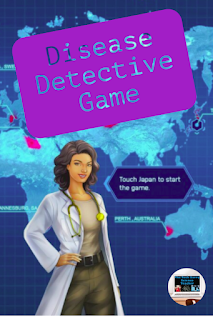
Dr. Spencer Striker, an Associate Professor of Digital Media Design at Northwestern University in Qatar, has released a new mobile game. Dr. Sara: Disease Detective is a fully interactive digital learning mobile game about epidemiology.

The game is designed to get kids interacting and having fun while developing problem-solving skills, logic skills, increasing their scientific vocabulary, and learning more about pandemics.  In this character-driven simulation of Epidemic Intelligence Service (EIS) detective work, students search for the index case, racing against time to find clues to a cure.

"Dr. Sara: Disease Detective features high stakes time pressure, compelling characters, narrative design, challenging puzzles, and the natural gameplay dynamics that emerge from network science and contact tracing," Dr. Striker said. "We hope this new visual novel mobile game will inspire students to develop an interest in science, medical technology, and public health."

This fun and immersive game features interactive dialogue, innovative character design, minigames about social distancing, hidden object investigation, eureka style logic puzzles, collectible scientific vocabulary, game-based learning techniques, cinematics, visual effects, original music, and immersive sound design.


Dr. Sara: Disease Detective is available on the Apple Store and Google Play. For more information, visit https://www.spencerstriker.com/work/disease-detective.

Take a look a quick overview of what this game is all about.


Tuesday, December 28, 2021

Comparative Anatomy in Pictures


eSkeletons is a great site for viewing skeletal models.  There are a number of mammalian skeletons that you can choose from and can even look at a specific bone.  While there are many sites that will allow you to view models of the skeleton, what I like about this site is that you can easily compare comparable bones of different organisms. 

It is a good website to add to your anatomy toolkit.

Tuesday, September 14, 2021

Frog Dissection App


I have found that fewer and fewer schools are offering dissections as part of their Biology/Life Science curriculum.  There are many reasons that this might be, but I still feel that students are missing out by not being able to do them.  The next best thing is doing dissection in person, which is to do a virtual dissection.  There are many options out there and depending on why type of tech you have in your classroom, there are various choices you have.

If you use iPads in your classroom, I recommend the Frog Dissection app. It is not a free app, but I think that it's worth it.  It's $3.99 which is a bit steep for an app, especially if you have to purchase 10-15 licenses.  The good thing is that you only have to make the purchase once.  Luckily Apple offers a volume purchase discount.  Ask your IT department if your school is signed up.

Do you do dissections in your classroom? 

Thursday, December 17, 2020

PhET meets PowerPoint

I've talked about PhET before, so you know that I love it! In case you don't know what it is, it's a website that has simulations that you can use in your physics, chemistry, biology, earth science, and mathematics classroom. Many of them are available as part of PhET's free PowerPoint Add-in.

While at first I found this add-in I didn't think much of it. I didn't see the value in it when you can just go to the website. While this is true, the great thing about this add in is that you can use the simulations just like you were on the website but you don't need to leave your PowerPoint presentation.

56 of the PhET simulations are available to insert into PowerPoint presentations through the use of the add-in . With the Add-in installed you can browse the available simulations and insert them into your slides. The simulations work in your slide just as they do on the PhET website.  A note about the add-in; if you are in a Microsoft school your Microsoft admin may have turned off the ability to use add-in or may have to approve them.  So if you are having trouble finding the add in, please reach out to your tech admin. 


Saturday, September 19, 2020

Interactive 3D Brain Model

BrainFacts.org launched an interactive 3D brain. You and your students can get up close and isolate sections, explore each region, and learn about brain health and disorders. It illustrates how our brains inform our bodies to stop at a red light, taste popcorn, or solve intricate problems.


The site also features brand-new interactive games and trusted peer-reviewed content. The whole site is easily accessible for non-scientists in living rooms and classrooms. It is a great tech advancement for students of all ages.


BrainFacts.org is overseen by an editorial board of leading neuroscientists from around the world. It is run by the Society for Neuroscience.


Sunday, August 16, 2020

A trip through the GI Tract [video]

The video below from the Canadian Museum of Nature shows the inside of the human digestive tract. It is a 3D, computer-generated animation that starts at beginning of the esophagus and ends at the anus.


Sunday, March 15, 2020

Short videos on the science topics you teach

I have always liked showing videos as part of my science classes, but I don't want to spend a whole period showing a video.  Plus, we know that the kids won't pay attention to a video that long anyway.  Check123 is a great site for finding short videos.  All areas are represented, but of course we all care about the science section. ;-)

The videos are all less than 4 minutes long.  You can do a search for what you are looking for and even narrow down the results based on the length of the video you are looking for.  For the most part these videos are hosted on YouTube, so if this is blocked in your school it won't work.  (On a side note, if it's blocked in your school you should really talk to the powers that be because it's a valuable teaching tool!)

What's one of your go to site for find videos for your classroom?

Thursday, February 6, 2020

Life Science Learning Center

The University of Rochester Medical Center has created the Life Science Learning Center for high school teachers.  It's a collection of lessons that have been tested by real teachers and students.  These are not your typical lessons, but rather ones that push students to really think and analyse the topics.  Some of these will be difficult for a 9th grade Biology class, but would be great for an upper level class like an AP or IB course.

Lesson topics include: Neuroscience, Cancer Biology, Biology of Drug Abuse and Addiction, AIDS Vaccine Case Study, Environmental Health, Kidney Crisis, Cholera, Nano Particles, Making tools of the Trade, Stem Cells and many more!

Sunday, December 8, 2019

Video Tutorial on how to use Zygote Body


You have read my walk through
of Zygote Body.  It's a great tool to use in both Biology and Anatomy classes.  I have created a short video to walk you through it visually for those of you who find that more helpful.


Saturday, November 2, 2019

Why Don't Antibiotics Work Like They Used To? - Example of a NGSS Lesson

If you are in one of the many schools around the country that are transitioning to the Next Generation Science Standards (NGSS) or have already made the transition you have the job of redesigning your lessons to meet these new standards.  The website www.nextgenscience.org has you covered.  You can find examples of quality NGSS designed lessons such as this one asking why antibiotics don't work they way the used to.   It part of the natural selection and evolution unit and explores the case of a girl with a life threatening bacterial infection.  As part of this lesson, students will design a model to explain how bacteria populations change over time.

The lessons you will find on this site were evaluated with the EQuIP Rubric for Science.  The rubric is designed to review existing lessons to provide criterion-based feedback and suggestions for improvement.  It can be a helpful tool as you are trying to develop your own NGSS aligned lessons.

Where you are finding quality NGSS lessons? 

Thursday, October 17, 2019

Virtuali-Tee (Human Body Augmented Reality Tee)

How cool is this t-shirt? It's wearable augmented reality! You can view the circulatory, respiratory and digestive systems and even has a heart rate tracker to visualize your heart beat.

You'll need to download the app to your phone but then all you need to scan your shirt and tap to view the different layers of your body. It even works in selfie mode.

Take a look at the video below or use the demo page to check it our yourself.   The t-shirt itself is a little pricey, but it could make a fun gift.


Friday, March 22, 2019

Free Online Textbooks

“I can’t find my textbook!” “I don’t remember getting a textbook.” Does this sound familiar to you? That is what I kept hearing at the end of every year. Then I would have to go through a big hassle of collecting money from student to repurchase the outdated textbooks that I had. I hated having to worry about students losing textbooks or that I was always replacing textbooks that I didn’t even want that included too much information or not enough information. Enter FlexBooks. FlexBooks are online textbooks from a company called CK12. I instantly liked them for many reasons, but the two big ones were that I could customize the book and that it could be posted on my website and downloaded by the students. This video does a great job of explaining how they work. While not every subject has a FlexBook they have a large list of books that include math and science books for elementary, middle and high school along with some other areas such as Writing, Astronomy, History and Engineering.

So, this sounds good you say, but how can I really use it in my classroom? I picked out a textbook that I wanted to use and then went through it to delete the things that don’t apply to my curriculum. I also added in some information that wasn’t there that I wanted to make sure my students had in their book. You can also include links to worksheets (CK12 has a workbook that goes along with most of their textbooks). Once it’s created you can save it as a PDF and post it on a web page or e-mail it to students. Even better, students can put the PDF on their computers, phones, Kindles, IPads, Nooks or other eReader. If you don’t want to customize your book you can find select FlexBooks already in Kindle or Nook/IPad/Android format.

Am I convincing you yet? Maybe you want to make sure you have a teacher’s edition to refer to or a book or worksheets or labs. Well, you got it! The workbooks that are available can also be customized so can you make them fit your classroom. I usually post them on my website and the students can have access to them all the time (no more “I lost it.”)

Looking for more? CK12 has a more interactive way of presenting information that allows you pull short concepts along with chapters into an online interactive “book” Many of the concepts include video clips and interactive quizzes.

Do you use textbooks in your classroom? 

crossposted on my Technology Blog - The Tech Savvy Science Teacher

Thursday, February 21, 2019

Biology/Living Environment Websites to use with your students


I am always looking for different websites I can use in my Biology classroom.  I like sites that I can use a demo with the whole class as well as those that students can use individually in stations or at home.  Here are a few that I found to be helpful.  I would love for you to share with me and fellow readers some sites that you have found helpful.

Genetic Decoder

This site gives students a structural view of the 5 DNA/RNA nucleotides.  It will also allow you to visualize the amino acids that are coded for by any combination of codons.  Lastly you can enter a DNA or RNA sequence and it will give you the amino acid sequence.

BioDigital Human

This is a human visualization platform that gives you and your students a 3D view of the human anatomy. You can add labels to the views and even quiz yourself.  I also like that you can see customized models to your library so you can use them from class to class and year to year.  There is also a gallery view so that you can view by system or even medical condition.

Cells Alive

This is a great site to introduce students to cell organelles.  I always used it with my middle school students as a way of introducing them to cells.  I used it along with a webquest.  You can find a number of different worksheets by doing a search for Cells Alive webquest, but the one I used was based on this one from The Biology Corner.

Cell Transport

This site allows your students to visualize the different types of transport that occur across a membrane (difussion, osmosis, passive transport and activive transport).  It also shows how proteins are ienvolved in this transport and how the proteins are regulated in order to regulate transport. 

Sunday, August 26, 2018

Images from inside the Womb


While reproduction and development wasn't my favorite topic to talk about with 14 year olds (I mean they laugh at everything), I always enjoyed seeing their amazement when I showed images of fetal development.  They were truely amazed by what fetuses look like and how they start off resembing the newborn very little.  While students enjoyed the comparisons between humans and other animals, I found that they were most interested in what they once looked like.  I came across a website that provides 10 images of human gestation along with some facts of what the baby can do at that stage.  I particually like that they facts accompany the images as students are often amazed at what a fetus can do at such an early age.

Monday, January 22, 2018

Collection of Science Teaching Resources

A while back I came across this website with a collection of science teaching resources.  It's a little old and I don't think it's being updated, but it's still a great resource.  Take a look at it and let me know what you found to be helpful or what you were hoping to find.


Wednesday, July 26, 2017

Genetic Mutations and Disease Interactive

HHMI has a Genetic Mutations and Disease Interactive that shows how mutations can occur.  We know that mutations are changes in DNA that can occur at any point.  Some of these mutations cause diseases and other don't depending on where in the genome they occur.  This interactive shows how mutations can affect a person if it occurs in either a somatic cell or a germ cell.


Friday, June 23, 2017

Chemistry and Biology online review questions and practice tests

For those of you who teach in New York, and even those who don't, you may have used the website RegentsPrep.org at some point. Unfortunately that site is down, but I may have an alternative for you. Syvum created a sort of alternative. This site goes back to past 15 years of so Regents exams and has created an interactive testing environment. Students can take any past test and the site will correct the answers for them. Students can even create a free account that will track their progress as well as give them the ability to mark specific question to back to for review. In addition, there are specific pages for Chemistry and Biology where students can focus in on a set of questions from a topic of their choice.

What do you like to share with students to have them practice on their own?